











Key Takeaways:
- Firms lose almost 27 percent of ready buyers due to slow flows and confusing screens that weaken deal movement.
- Mobile apps raise conversions by over 31 percent by giving faster decisions, clearer paths, and easier daily use.
- Clients compare multiple platforms, so quick replies, accurate updates, and simple viewing keep them from switching.
- User data from searches and actions helps you forecast demand, improve selling steps, and reduce costly delays.
- A dedicated app strengthens trust, improves operations, and brings higher-quality leads without increasing acquisition spending.
‘’When buyers feel lost on your platform, they leave before you even know they were ready to act.’’
Most teams with whom we speak with say the same thing- users visit their site, tap around for a moment, then vanish. According to our analysis, it happens because the flow feels outdated, the search feels tiring, and the entire journey demands too much effort.
That drop impacts lead quality, lowers trust, and pushes potential deals toward competitors who offer smoother paths. Many businesses report losing nearly 27 percent of high-intent users due to these gaps.
But not anymore!
This blog will take you through how a real estate mobile app changes that pattern. You will see how mobile app development for real estate improves buyer movement, increases retention, and even lifts conversions by over 31 percent in some cases.
By the end, you will know how real estate mobile app services can finally fix the friction that slows your growth.
Lets get started.
Real Estate Mobile App Development- A Quick Overview
The development of real estate mobile apps includes building user-friendly platforms for searching properties, viewing listings, taking virtual tours, and facilitating communication between clients and agents.
A real estate mobile app improves accessibility and personalization while providing real-time updates, which boosts user engagement.
Key features often include GPS integration, mortgage calculators, and push notifications.
Designed for a smooth user experience, mobile app development for real estate simplify the processes of buying, renting, and selling properties, thereby revolutionizing the digital industry of the real estate market.
How Big is the Real Estate Industry in the US?
According to a report: –
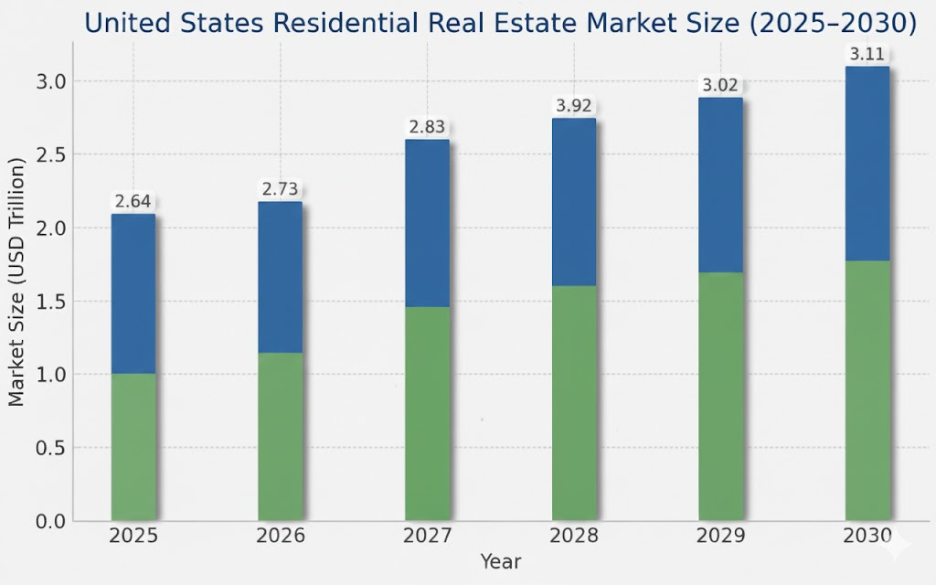
The size of the United States residential real estate market is estimated to be USD 2.64 trillion in 2025 and is expected to reach USD 3.11 trillion by 2030, growing at a compound annual growth rate (CAGR) of 3.33% during the forecast period from 2025 to 2030.
Key Highlights of the Report
- In 2024, apartments and condominiums accounted for 81% of the revenue share in the United States residential real estate market.
- The market for single-family build-to-rent projects is expected to propel this segment with a CAGR of 2.10% from 2025 to 2030.
- Regarding business models, the sales channel represented 78% of the market share in 2024.
- The rental channel is projected to grow at a CAGR of 2.26% during the same period from 2025 to 2030.
- By price band, mid-market homes made up 48% of the United States residential real estate market size in 2024.
What are the Different Types of Real Estate Mobile Apps?
Real estate mobile apps are specialized tools designed to meet various property-related needs. These real estate mobile apps can be categorized into several types, including listing platforms, agent tools, and transaction facilitators.
1. Listing & Search Apps
Platforms such as Zillow and Realtor.com allow users to browse properties, filter search results, and view detailed listings.
2. Real Estate Agent Apps
Tools like the Realtor.com Agent App help real estate professionals in managing clients, listings, and market data while on the move.
3. Mortgage & Financial Calculators
This mobile app for real estate helps users calculate loan payments, determine affordability, and navigate the pre-approval process.
4. Property Management Apps
Software such as AppFolio allows landlords and property managers to handle rentals, maintenance, and tenant communication efficiently.
5. Home Design & Renovation Apps
Applications like Houzz provide inspiration for home improvement projects, assist with product sourcing, and connect users with contractors.
6. Commercial Real Estate Apps
Platforms like LoopNet and CoStar are specifically focused on listing and searching for retail, office, and industrial properties.
7. Real Estate Investment (REI) Apps
When it comes to real estate mobile app development, tools like DealCheck help investors analyze property deals by calculating cash flow and assessing return on investment (ROI).
What is the Need for Real Estate Mobile Application Development?
Real estate mobile applications are crucial for overcoming modern digital challenges that hinder transaction efficiency and customer engagement.
Real estate app development address significant industry pain points by utilizing the immediacy and accessibility of mobile technology.
Given below are some of the issues that highlight the need for real estate mobile app development: –
Overwhelming Information Fragmentation
- Property listings are scattered across numerous websites and portals, making it exhausting for buyers to conduct comprehensive searches.
Inefficient Viewing Logistics
- Coordinating and traveling to multiple in-person property tours is time-consuming for everyone involved.
Rising Customer Expectations for Instant Responses
- Modern clients expect immediate replies, real-time updates, and 24/7 access, which traditional brokerages often struggle to provide.
Intense On-the-Go Competition
- Agents lose potential opportunities without tools that can instantly match new listings to client profiles or send push notifications while on the move.
Declining Engagement with Static Content
- Printed brochures and standard websites fail to capture attention in the same way that interactive and immersive formats do.
Challenges in Building Digital Trust
- In a low-trust environment, establishing authenticity for listings and agent credibility requires transparent, verifiable digital proof.
- Consistent visual branding — from app interfaces to how businesses design logos — plays a key role in building recognition, professionalism, and long-term user trust.
Data Opacity and Inconsistency
- Clients often encounter inaccurate or outdated listing information, leading to frustration, mistrust, and wasted effort.
Start Your Real Estate App Project Today
Give your buyers a faster and stronger property search that improves deals without extra effort.
Top 10 Reasons Why Should Invest in Real Estate Application Development
Investing in real estate application development offers a high-value opportunity to engage modern clients while streamlining operations.
mobile app development for real estate is essential for staying competitive and capturing market share in the digital marketplace.
These are the top 10 benefits of real estate mobile application development for businesses:
1. 24/7 Virtual Property Showcases
Applications allow potential buyers and tenants to take immersive virtual tours anytime, significantly expanding viewing hours and convenience.
2. Better Customer Reach & Engagement
A dedicated app will keep your brand easily accessible, allowing for direct communication, push notifications for new listings, and ongoing engagement with users.
3. Simplified Agent and Client Operations
Apps centralize and automate tasks such as scheduling viewings, managing documents, and facilitating communication, increasing efficiency for everyone involved.
4. Data-Driven Market Insights
With real estate mobile application development, in-app analytics provide valuable data on user behavior, popular listings, and market trends, enabling informed business decisions.
5. Improved Lead Generation and Qualification
Integrated inquiry forms and user activity tracking allow for more effective lead capture and qualification compared to traditional methods.
6. Competitive Market Advantage
A feature-rich, user-friendly app distinguishes your brand from competitors who still rely on basic websites or third-party portals.
7. High Return on Investment (ROI)
While the initial development cost may seem significant, it is often offset by increased sales, reduced operational expenses, and higher commission yields due to improved efficiency.
8. Secure and Centralized Document Management
Apps provide a secure platform for storing and sharing essential documents, such as contracts, leases, and disclosure forms, simplifying transactions.
9. Building Brand Authority and Trust
Mobile app development for real estate will establish your company as a modern, tech-savvy, and reputable leader in the industry.
10. Integration with Prop tech Innovations
A well-designed app can incorporate emerging technologies such as AI for personalized recommendations, IoT for smart home features, and blockchain for secure contracts.
Key Features of a Real Estate Mobile App
A scalable real estate mobile app combines comprehensive property search tools with personalized user functionalities to improve the buying, selling, and renting experience.
Some of the key real estate mobile app features are: –
Advanced Search and Filters
- With a good real estate mobile app design, users can search for location, price, property type, and amenities such as nearby schools or transit options.
High-Quality Media
- The app offers interactive 360° virtual tours, high-definition photos, and video walkthroughs to provide a detailed view of properties.
Accurate Map Integration
- With a good real estate mobile app UI design, interactive maps will display neighborhood insights and commute times, helping users make informed decisions.
Saved Searches and Alerts
- Users can save their favorite listings and receive instant push notifications for new matches.
Mortgage and Affordability Calculators
- Built-in tools help users estimate mortgage payments and budget effectively.
Direct Agent Communication
- The app features in-app calling, messaging, and scheduling options for easy communication with real estate agents.
User Profiles and Listings
- Registered users can manage their saved properties and list their own properties for sale or rent.
How Much Does It Cost to Build a Real Estate App in 2026?
The cost of developing a real estate app primarily depends on its complexity and the features included.
For a Minimum Viable Product (MVP) with basic listings and search functionalities, the starting price usually ranges from USD 15,000 to USD 20,000.
On the other hand, a more complex and feature-rich app that includes elements such as virtual tours, artificial intelligence, or advanced analytics can cost anywhere from USD 30,000 to over USD 100,000+.
It is ideal to outsource your app development project to India, by partnering with a leading app development company like Vrinsoft, as Indian developer hourly rates are highly competitive, making it a cost-effective option on a global scale.
The table below reflects the average real estate mobile app development price along with an estimated timeline: –
| App Type / Complexity Level | Estimated Cost (USD) | Estimated Timeline |
|---|---|---|
| Basic MVP (Minimum Viable Product) | $15,000 – $25,000 | 3 – 6 Months |
| Mid-Level Listing & Search App | $25,000 – $50,000 | 5 – 8 Months |
| Marketplace App (Buy/Sell/Rent) | $40,000 – $75,000+ | 7 – 10 Months |
| Property Management App | $50,000 – $90,000+ | 8 – 12 Months |
| Advanced/Enterprise App (AI/AR) | $75,000 – $150,000+ | 9 – 15+ Months |
5 Businesses Who Succeeded with Mobile App Development For Real Estate
Five prominent real estate firms in the United States have suceeded by utilizing custom mobile apps for property listings, virtual tours, and tools for agents.
1. Zillow
The company transformed property searches with its app, which features interactive maps and instant valuations, significantly boosting user engagement and solidifying its market dominance.
2. Apartments.com
Focused on rental properties, this platform excelled by providing verified listings and virtual tours.
It generates revenue through subscriptions and advertisements targeted at landlords.
3. Homesnap
The app empowers real estate agents with smart tools to improve client connections and advertising efforts, improving professional efficiency in transactions.
4. Redfin
It simplifies the buying and selling process by offering real-time updates and agent matching, effectively capturing a substantial share of the market through its mobile-first features.
5. Realtor.com
This app provides comprehensive listings and neighborhood insights, driving user retention and facilitating successful deal closures.
Way Forward- Build a Profitable Real Estate Mobile App with Vrinsoft
If you want solid growth without constant delays or trial-and-error, partnering and hiring a real estate mobile app developer who understands this space will save your time and effort.
At Vrinsoft Technology, we have 15+ years of industry experience, successfully completed 2K+ projects, and served over 900+ clients, which gives your plan a strong base from the start.
Our team has delivered solutions for several finance-focused businesses such as a Construction Estimation App, a Villas Property Management Platform, an Online Rental Property Marketplace, and other large systems built for scale.
With Vrinsoft, you get real estate mobile app development services shaped for growth and long-term use, backed by the best real estate mobile app development company in USA that knows how to turn ideas into revenue.
You can review our portfolio to see how we build results that last.
Contact or simply call us to start your FREE Conversation now.
India- +917227906117
USA- +17472283878





 sales@vrinsofts.com