









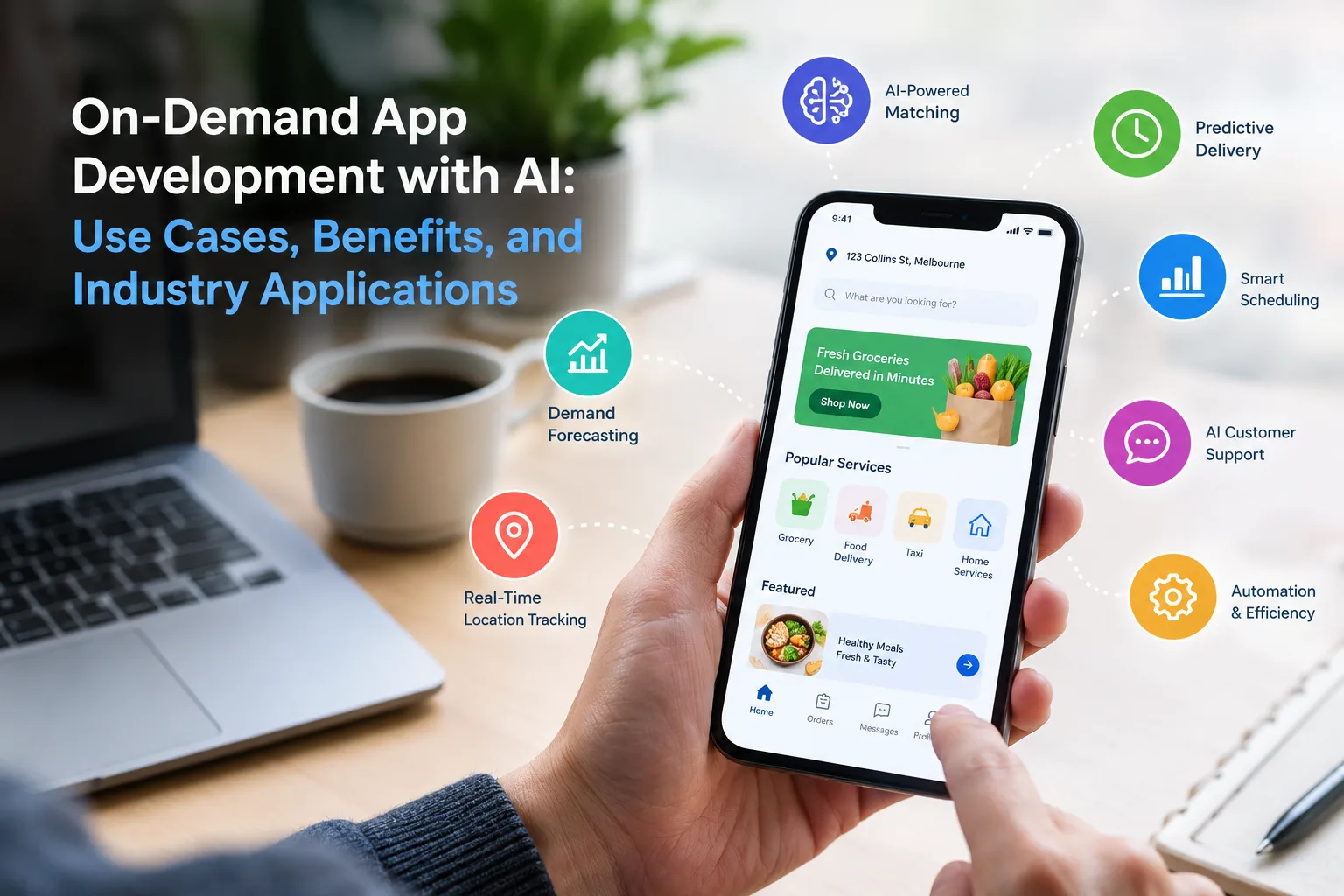
A customer orders groceries and expects them in 20 minutes. Ten minutes later, traffic worsens, several nearby orders come in, and the assigned delivery partner is still finishing another trip. The app has all this data, but a basic on-demand system may only react after the delay happens. AI can help predict these situations earlier and support better decisions in real time.
AI-powered on-demand app development brings artificial intelligence into the workflows behind ordering, booking, matching, scheduling, delivery, and customer support. Retail, delivery, logistics, home services, travel, and pet services can use AI differently based on their users, operational data, and business requirements.
For businesses planning an AI-powered platform, the challenge is deciding where AI can create real value without adding unnecessary complexity or cost. As an AI development company, Vrinsoft helps businesses build on-demand apps with AI capabilities across mobile apps, backend systems, cloud infrastructure, data, and third-party integrations.
What AI Adds to On Demand Mobile App Development
Forecast order and booking volumes by location and time so businesses can prepare inventory, workers, vehicles, or delivery capacity before demand rises.
- Intelligent Service Matching
Match each request with the most suitable provider using skills, availability, distance, ratings, past performance, and job requirements.
- Predictive Delivery and Arrival Times
Estimate actual arrival times using preparation delays, traffic conditions, weather, route history, and provider behavior instead of distance alone.
- Smart Order and Job Assignment
Assign multiple orders or service requests based on capacity, location, deadlines, and current workload to reduce idle time and delays.
- Personalized Service Recommendations
Recommend products, providers, destinations, or services based on previous purchases, searches, preferences, and recurring needs.
- AI-Powered Visual Assessment
Analyze customer-uploaded images to estimate cleaning jobs, identify visible issues, assess products, or support service requests before a provider arrives.
- Predictive Cancellation and No-Show Detection
Identify bookings that are more likely to be cancelled or missed so the platform can trigger reminders, waitlists, or replacement assignments.
- AI Support for Operational Decisions
Give operators real-time insights into order spikes, delayed jobs, supply shortages, unusual activity, and service bottlenecks.
Also Read: On-Demand Apps Business Model: How Profitable On-Demand Apps Make Money in 2027
AI Use Cases Across On-Demand Industries
The value of AI changes with each on-demand business model. Retail apps can predict product demand while logistics platforms can optimize shipments. By partnering with a reliable On Demand app development company like Vrinsoft, you can build AI powered on-demand app to stand out in the market.
AI in On-Demand Retail App Development
For businesses investing in on demand retail app development, AI can connect customer behavior with inventory and purchasing data to improve both shopping and retail operations.
- Smart product recommendations based on browsing history, purchases, and customer preferences.
- Demand forecasting to predict which products may see higher demand by location or period.
- Visual search that lets customers find products using uploaded images.
- Inventory predictions that can flag potential stock shortages before they affect orders.
AI in On-Demand Logistics App Development
With on demand logistics app development, AI can help businesses coordinate shipments, vehicles, warehouses, and delivery schedules using real-time operational data.
- Intelligent load matching based on shipment requirements, vehicle capacity, and available resources.
- Route re-planning when traffic, weather, delays, or delivery priorities change.
- Late-shipment prediction using route history, current conditions, and delivery progress.
- Fleet demand forecasting to help position vehicles and resources ahead of busy periods.
AI in On-Demand Delivery App Development
An on-demand delivery app development strategy can use AI to coordinate orders, preparation times, delivery partners, and customer expectations. Our On Demand app development company has worked on many projects for delivery models in different countries, providing expert services to generate demands.
- Smart order batching that groups suitable deliveries based on location and timing.
- Preparation-time prediction using historical order and business data.
- Courier assignment based on location, workload, availability, and predicted delivery time.
- Delivery delay alerts that identify potential problems before an order misses its expected arrival time.
AI in On-Demand Home Services App Development
Businesses using on demand home services mobile app development can apply AI to match customers with suitable professionals and assess service requirements before a visit.
- Skill-based matching based on service type, provider skills, location, availability, and past performance.
- Photo-based job assessment that can review customer-uploaded images before assigning a professional.
- No-show prediction that can identify bookings requiring additional confirmation or follow-up.
- Service recommendations based on previous bookings and recurring customer requirements.
AI in On-Demand Travel App Development
For on demand travel app development, AI can turn booking and travel data into personalized recommendations while helping users respond to changing plans.
- Personalized itinerary planning based on destination, preferences, budget, and available time.
- Travel recommendations based on previous searches, bookings, and user interests.
- Price monitoring can identify meaningful changes across flights, hotels, or other travel services.
- Rebooking assistance can suggest alternative options when a booking changes or becomes unavailable.
AI in On-Demand Pet Services
Businesses building on demand pet services apps can use AI to match pet owners with suitable care providers while supporting bookings, scheduling, and personalized services.
- Pet-care provider matching based on pet type, temperament, care requirements, location, and provider experience.
- Personalized service recommendations based on previous bookings, pet profiles, recurring needs, and owner preferences.
- Smart scheduling that identifies recurring care patterns and suggests suitable booking times.
- Service monitoring that uses location and booking data to identify unusual changes during scheduled pet-care services.
- Dog walking support can help platforms match pets with suitable walkers based on location, availability, and experience.
Also Read: Top 10 Service Industries Driving the On-Demand Economy
Vrinsoft On Demand Mobile App Development Case Studies
We have hands-on experience developing on-demand platforms for different business requirements. As a leading On Demand app development company, these projects demonstrate our experience with customer applications, service providers, scheduling, payments, communication, order management, and other core workflows required for on-demand platforms.
On Demand Service Provider App
Vrinsoft developed native Android and iOS applications along with a website for a platform connecting customers with local service professionals. The solution supports service discovery, project requests, provider bidding, real-time chat, order management, secure payments, reviews, ratings, and provider portfolios.
- Platform: Native Android and iOS apps with a web platform
- Key features: Provider bidding, matchmaking, real-time chat, order management, secure payments, reviews, ratings, and portfolios
- Technology: Swift, Kotlin, and PHP Laravel
- Use case: Connecting customers with suitable local professionals through an on-demand service platform
Case Study: On Demand Service Provider App Development by Vrinsoft
On-Demand Food Delivery App
Vrinsoft developed Android and iOS applications along with a website for a breakfast-focused food delivery business offering customized weekly and monthly meal plans. The platform supports meal subscriptions, scheduled deliveries, real-time availability, secure payments, push notifications, and order management.
- Platform: Android, iOS, and web
- Key features: Meal subscriptions, customized meal plans, order scheduling, real-time availability, push notifications, and secure payments
- Technology: Flutter and PHP Laravel
- Use case: Managing customized meal orders and scheduled food deliveries through an on-demand platform
Case Study: On demand Food Delivery App Development by Vrinsoft
How AI Fits Into an On-Demand App Architecture
AI works as part of the wider application architecture rather than operating as a standalone feature. Customer and provider apps generate data through searches, bookings, payments, locations, and service activity. The backend processes these events while the AI layer uses relevant data to produce recommendations, predictions, matching decisions, or automated responses. Cloud infrastructure then supports model hosting, data storage, monitoring, and scaling as usage grows.
- Customer App: Collects searches, bookings, preferences, feedback, and other user activity that can support AI-driven personalization.
- Provider App: Shares availability, location, service status, performance data, and job updates for matching and operational predictions.
- Backend Services: Connects app workflows with databases, business rules, APIs, payments, notifications, and AI services.
- Real-Time Layer: Processes live location, order status, availability, and dispatch events where decisions need to happen quickly.
- AI Layer: Runs recommendation, prediction, matching, classification, chatbot, and other machine learning capabilities.
- Data Layer: Stores historical transactions, customer activity, operational records, and model-related data for analysis and training.
- Cloud Infrastructure: Provides computing resources, model hosting, storage, monitoring, and scaling as application usage increases.
Also Read: On Demand App Development Guide for Business Owners
Integrations AI-Powered On-Demand Apps Need
AI depends on reliable data from the systems connected to an on demand service app development. Payments, maps, inventory, scheduling, communication, and business platforms can provide the signals needed for accurate predictions and automated decisions. Choosing the right integrations also helps the app exchange data consistently while giving AI features access to current information.
- Maps and Location APIs: Provide real-time location, routes, traffic conditions, distance, and geospatial data for delivery estimates, provider matching, and route planning.
- Payment Gateways and Wallets: Connect transactions, refunds, payment status, and customer activity to support secure checkout and AI-based fraud detection.
- POS and Inventory Systems: Supply product availability, sales history, and stock information that AI can use for recommendations, demand forecasting, and substitution suggestions.
- ERP and Business Systems: Connect operational records with the app so AI can analyze orders, resources, inventory, and other business data from a wider context.
- Telematics and IoT Platforms: Provide vehicle, equipment, location, temperature, and operational data for logistics, delivery monitoring, predictive analysis, and fleet planning.
- Communication Services: SMS, WhatsApp, email, and push notification integrations can deliver AI-generated updates, reminders, booking alerts, and customer support responses.
- AI APIs and Model Services: Connect the application with language, vision, speech, recommendation, and predictive AI capabilities without requiring every model to be developed from scratch.
- Identity and Verification Services: Provide identity, license, background-check, and account verification data for platforms that connect customers with service providers.
Also Read: How to Build a Successful On-demand Delivery App?
The AI Feature Ladder for On-Demand Apps
AI should grow alongside the data and operational needs of an on-demand platform. A new app may benefit more from focused AI features, while a high-volume platform can support more advanced models trained on larger datasets.
| App Stage | Typical Situation | AI Features to Consider |
|---|---|---|
| Early Stage | The app is building its first customer base and has limited historical data. | Rule-based matching, AI chatbot, basic recommendations, ETA estimation |
| Growing Stage | The platform has enough activity to identify recurring customer and operational patterns. | Demand forecasting, smart dispatch, personalized recommendations, fraud alerts |
| High-Volume Stage | The platform processes large volumes of transactions and has substantial historical data. | Custom prediction models, dynamic resource allocation, advanced matching, predictive pricing |
| Mature AI Stage | AI is integrated across multiple business workflows and decisions. | Real-time optimization, automated decision support, advanced forecasting, multi-model AI systems |
Security, Testing, and Compliance for AI-Powered On-Demand Apps
An AI-powered on-demand app handles more than customer bookings and payments. It may process provider information, live locations, behavioral data, AI prompts, and operational records. Security, testing, and compliance should therefore be considered during development rather than added shortly before launch.
- Protect Customer and Provider Data
Customer profiles, provider records, booking history, location data, and service details should be protected through encryption, access controls, secure APIs, and appropriate data retention policies.
- Secure Payments and Administrative Access
Payment tokens should be handled through trusted payment systems while admin accounts require strong authentication and role-based permissions. Audit logs can also help track sensitive administrative activity.
- Protect AI Inputs and Outputs
AI support features can receive personal or business information through customer conversations. Input filtering, access controls, prompt protection, and output monitoring can reduce the risk of sensitive data being exposed through AI responses.
- Test Real-World App Conditions
AI-powered on demand service app development need testing beyond standard functional checks. Load tests can simulate busy periods while field testing can assess GPS accuracy, weak networks, delayed APIs, and lower-end devices.
- Validate AI Decisions Before Launch
Shadow mode can run an AI model without allowing it to control live decisions. Teams can compare its predictions with real outcomes and measure metrics such as ETA accuracy, provider acceptance, recommendation quality, or forecast accuracy before wider deployment.
- Test AI Behavior Continuously
AI features can change as models, prompts, APIs, and datasets change. Regression testing, chatbot testing, accuracy monitoring, and periodic model evaluation can help identify problems after updates.
- Account for Regional Privacy Requirements
Apps serving customers across the UK, Australia, the US, or EU may face different privacy requirements. The applicable rules depend on the data collected, services offered, and markets served, so privacy controls should be planned around the actual deployment regions.
- Consider Payments and Worker Requirements
Payment processing may require compliance with relevant payment security standards, while platforms using independent service providers may need to consider worker classification rules that vary between markets.
- Keep Compliance Part of Product Planning
Privacy notices, consent mechanisms, data retention, access controls, security reviews, and audit processes should be considered alongside product requirements. Businesses should also confirm market-specific legal requirements with qualified legal professionals before launch.
How Much Does AI Add to On-Demand App Development Cost?
Adding AI can increase on-demand app development costs by around $10,000 to $100,000+, depending on the AI capabilities, data requirements, integrations, model complexity, and platform scale. Basic AI features using third-party APIs may sit at the lower end, while enterprise AI systems with multiple models, custom data pipelines, real-time processing, advanced analytics, and stronger governance can require a larger investment.
| AI Layer | Typical AI Capabilities | Estimated Additional Cost |
|---|---|---|
| Basic AI Layer | AI chatbot, simple recommendations, AI API integration, basic automation | $10,000 to $20,000 |
| Intelligent AI Layer | Demand forecasting, smart matching, fraud detection, predictive ETAs | $20,000 to $40,000 |
| Advanced AI Layer | Custom prediction models, intelligent dispatch, advanced recommendations, predictive analytics | $40,000 to $60,000 |
| Enterprise AI Layer | Multiple AI models, real-time optimization, custom data pipelines, advanced analytics, AI governance | $60,000 to $100,000+ |
The final budget depends on more than the AI layer. Customer and provider apps, admin dashboards, cloud infrastructure, third-party integrations, data preparation, security testing, and ongoing model monitoring can also affect the overall on-demand app development cost.
For smaller platforms, starting with one focused AI capability can keep the initial investment manageable while generating useful data for future improvements. Larger platforms may require multiple AI models and dedicated infrastructure from the beginning to support higher transaction volumes and complex operational workflows.
Why Choose Vrinsoft for AI-Powered On-Demand App Development?
Building an AI-powered on-demand app requires experience across mobile development, backend systems, AI, data, cloud infrastructure, and third-party integrations. Vrinsoft brings hands-on experience across different types of on-demand app development, helping businesses build platforms around their industry, workflows, users, and growth plans.
- We have hands-on experience across different types of on-demand app development, including retail, delivery, logistics, home services, travel, and pet services.
- Our AI development capabilities support demand forecasting, intelligent matching, recommendations, predictive ETAs, automation, and AI-powered customer support.
- We build customer apps, provider apps, admin dashboards, backend systems, and APIs around each business’s operational requirements.
- Our team integrates payments, maps, POS, ERP, inventory, communication platforms, IoT systems, and AI services into on-demand applications.
- Businesses can start with focused AI capabilities and expand toward advanced or enterprise AI as their users, data, and operational requirements grow.
Conclusion
AI is changing what an on-demand app can do beyond basic bookings, payments, and service requests. Predictive demand planning, intelligent matching, personalized recommendations, smart dispatch, and AI support can help businesses make better decisions while creating more relevant customer experiences.
The right approach depends on the industry, available data, platform scale, and business goals. A new app may start with focused AI features and gradually introduce more advanced capabilities as usage and data increase. Retail, delivery, logistics, home services, travel, and pet services can each apply AI to different operational challenges.
Vrinsoft combines hands-on experience in on-demand app development with AI, mobile, backend, cloud, data, and integration capabilities. Talk to Vrinsoft to discuss your on-demand app idea and get a customized development estimate.



 sales@vrinsofts.com