









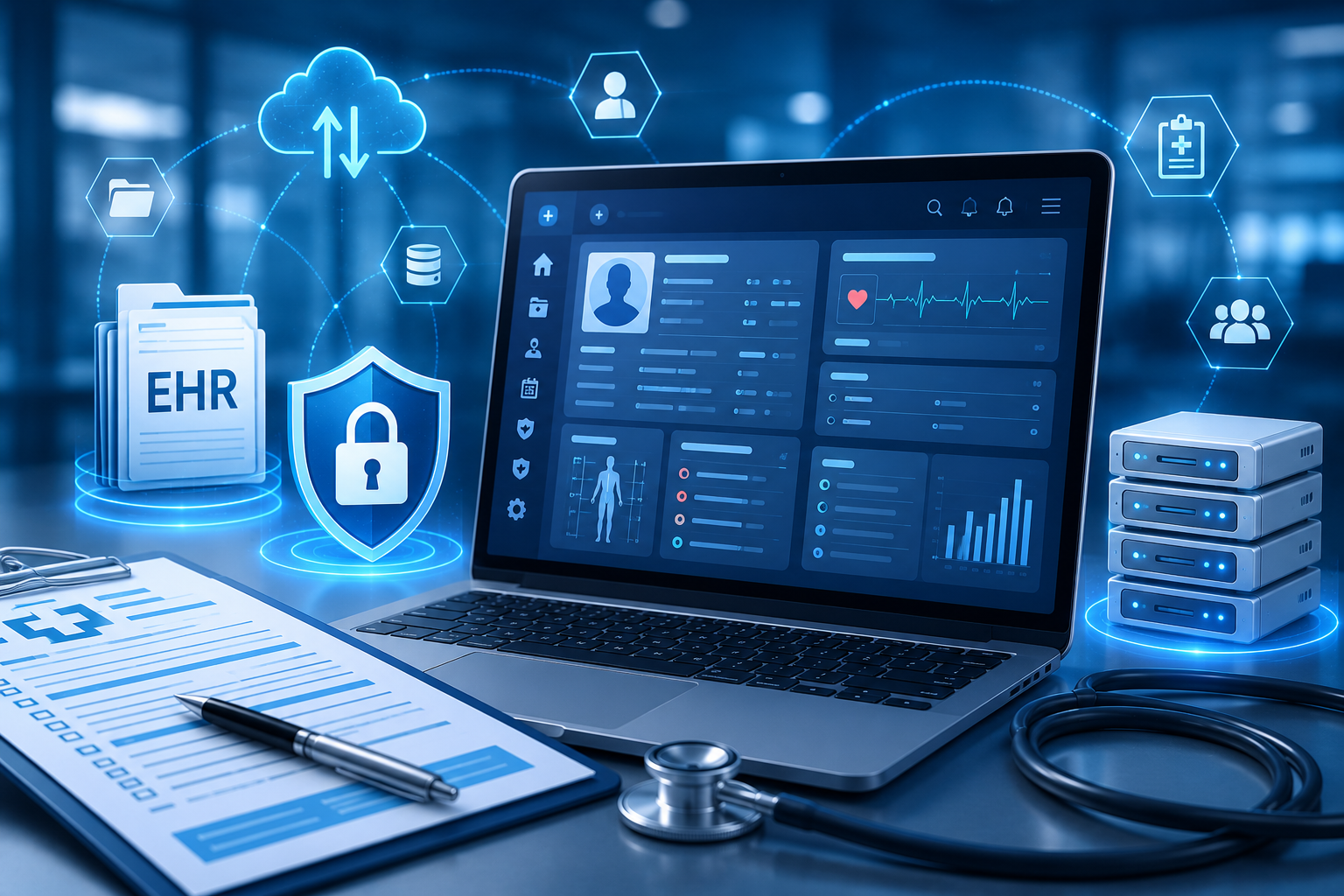
Key Takeaways:
- Custom EHR software provides greater flexibility, scalability, and workflow customization than off-the-shelf solutions.
- Security, HIPAA compliance, and patient data protection should be built into every stage of EHR development.
- Interoperability standards like HL7 and FHIR are essential for seamless healthcare data exchange.
- Core EHR features include patient records, e-prescribing, telehealth, billing, analytics, and clinical documentation.
- Development costs depend on platform complexity, integrations, compliance requirements, and scalability goals.
- AI, cloud infrastructure, and predictive analytics are shaping the future of modern EHR systems.
If you’re exploring EHR software development, you’re likely facing a challenge common across healthcare organizations in the United States.
Whether your hospital is struggling with disconnected systems, your healthcare startup needs a scalable digital health platform, or your clinic has outgrown an off-the-shelf solution, the goal is the same: creating a more efficient, connected, and patient-focused healthcare environment.
This leads to an important question: Should you invest in custom EHR software development?
For many healthcare providers, the answer is increasingly yes.
Modern healthcare depends on secure, real-time access to patient information while meeting strict requirements around protected health information (PHI), interoperability, insurance workflows, and regulatory compliance. Unfortunately, many legacy EHR platforms lack the flexibility needed to support today’s clinical and operational demands.
That’s why hospitals, physician groups, specialty clinics, healthcare startups, and digital health companies are investing in custom EHR software development services that provide greater scalability, integration capabilities, and long-term control.
At Vrinsoft Technology, a leading software development company in USA, we help healthcare organizations across the US and countries worldwide build secure, compliant EHR solutions. Our team ensures that the system is designed around each client’s unique workflows and growth objectives.
In this comprehensive guide, we’ll explore everything you need to know about electronic health record development, including:
- What EHR software development involves
- How to build an EHR system
- Essential features every modern EHR needs
- The role of EHR developers
- Compliance and security requirements
- EHR software development cost
Let’s dive in.
What Is EHR Software Development?
EHR software development refers to the process of designing, building, implementing, and maintaining Electronic Health Record systems that digitally manage patient health information.
An EHR system serves as the central repository for healthcare data, allowing authorized providers to access patient records securely and efficiently.
Instead of relying on paper records or disconnected software solutions, healthcare organizations use EHR platforms to manage:
- Patient demographics
- Medical histories
- Clinical documentation
- Diagnoses
- Treatment plans
- Prescription records
- Laboratory results
- Imaging reports
- Appointment scheduling
- Billing information
- Insurance details
However, modern EHR software development goes far beyond simply digitizing patient records.
Today’s healthcare organizations need platforms that support interoperability, telehealth, AI-powered decision-making, remote patient monitoring, analytics, and seamless integrations with third-party healthcare systems.
The goal is not just to store information. It’s to improve patient care, streamline operations, and support better healthcare outcomes.
Why US Healthcare Organizations Are Choosing Custom EHR Software Development
Let’s be honest.
Many healthcare providers start with commercially available EHR solutions because they’re quick to deploy.
But as organizations grow, many begin encountering limitations.
You may find yourself asking:
- Why can’t we customize workflows?
- Why are integrations so complicated?
- Why are clinicians spending more time documenting than treating patients?
- Why are licensing costs increasing every year?
These frustrations often lead organizations to explore custom EHR software development.
Unlike generic solutions, custom EHR systems are built specifically around your workflows, business processes, compliance requirements, and long-term goals.
So, as a leading healthcare software development company, we often guide our clients to invest in scalable EHR system design for their specific needs.
Planning a Custom EHR Platform for Your Healthcare Organization?
Vrinsoft Technology helps hospitals, clinics, healthcare startups, and digital health providers build secure, HIPAA-compliant EHR systems tailored to their workflows, integrations, and growth goals.
Benefits of Custom EHR Development
Here are some of the key advantages why medical institutions are investing in EHR software development:
1. Workflow Customization
Every healthcare organization operates differently.
A hospital network, mental health practice, urgent care center, and telemedicine startup all have unique requirements.
Custom EHR development allows you to design workflows that match your clinical operations instead of forcing your staff to adapt to rigid software limitations.
2. Improved Scalability
As your organization grows, your EHR should grow with you.
Custom solutions provide flexibility to add:
- New locations
- Additional providers
- New specialties
- Telehealth services
- Advanced analytics
- AI-powered tools
3. Better Integration Capabilities
Healthcare ecosystems are becoming increasingly connected.
Custom EHR platforms can integrate with:
- Laboratory systems
- Pharmacy networks
- Insurance providers
- Telehealth platforms
- Medical devices
Revenue cycle management tools
4. Greater Data Ownership
With a custom solution, you maintain greater control over your data, security architecture, and future development roadmap.
For healthcare organizations in the United States, this level of flexibility is becoming increasingly important as providers focus on improving operational efficiency, supporting value-based care models, and preparing for future healthcare innovations.
Custom EHR platforms allow organizations to build systems that support:
- Better clinical decision-making
- Improved care coordination
- Reduced administrative workload
- More personalized patient experiences
- Future technologies such as AI and predictive analytics
As healthcare continues to evolve, organizations need EHR platforms that are designed not only for today’s requirements but also for future growth.
Who Needs EHR Software Development Services?
When people hear EHR systems, they often think only of hospitals.
The reality is much broader.
A. Hospitals and Health Systems
Large healthcare organizations require enterprise-grade EHR platforms that support thousands of users, multiple departments, and extensive interoperability requirements.
B. Healthcare Startups
Digital health startups frequently build innovative care delivery models that traditional EHR systems cannot adequately support.
Custom development enables startups to create differentiated healthcare experiences.
C. Specialty Clinics
Cardiology, oncology, behavioral health, dermatology, and other specialties often require highly customized workflows and documentation templates.
D. Telehealth Providers
Virtual care platforms depend heavily on integrated EHR functionality to maintain continuity of care.
E. Ambulatory Care Centers
Outpatient facilities benefit from streamlined workflows and efficient patient management systems.
F. Healthcare Networks and Accountable Care Organizations (ACOs)
Healthcare networks and Accountable Care Organizations require connected EHR platforms that support coordinated care, population health management, quality reporting, and data-driven decision-making across multiple providers and facilities.
Custom EHR Software Development vs Off-the-Shelf EHR Solutions
One of the biggest decisions healthcare organizations face is whether to purchase an existing EHR platform or invest in a custom-built solution.
For hospitals, healthcare startups, and specialty providers with specific requirements, custom EHR development often provides greater long-term value.
The right choice depends on factors such as:
- Organization size
- Workflow complexity
- Integration requirements
- Growth plans
- Compliance needs
- Budget considerations
While off-the-shelf EHR systems can help organizations quickly digitize records, they may not always meet the unique needs of growing healthcare providers.
| Custom EHR Development | Off-the-Shelf EHR Software |
|---|---|
| Designed around your workflows | Requires adapting workflows to the software |
| Fully customizable features | Limited customization options |
| Greater control over integrations | Depends on vendor capabilities |
| Scalable for future growth | May have scalability limitations |
| Supports unique healthcare models | Built for general use cases |
| Greater ownership and flexibility | Vendor dependency |
Essential Features Every Modern EHR System Should Include
One of the biggest questions organizations ask is: What features should an EHR system have?
While requirements vary, certain features have become essential.
1. Patient Record Management
This is the foundation of every EHR platform.
Providers need instant access to:
- Patient histories
- Diagnoses
- Medications
- Allergies
- Immunization records
- Treatment plans
The faster clinicians can access information, the more efficiently they can provide care.
2. Appointment Scheduling
Scheduling tools help reduce administrative burden while improving patient experiences.
Modern scheduling systems should include:
- Online booking
- Appointment reminders
- Calendar synchronization
- Waitlist management
- Provider scheduling
3. Clinical Documentation
Documentation remains one of the biggest challenges in healthcare.
An effective EHR should simplify documentation through:
- Smart templates
- Voice recognition
- Clinical note automation
- Structured data entry
- AI-assisted documentation
Reducing documentation time allows providers to focus more on patient care.
4. e-Prescribing
Electronic prescribing capabilities help improve medication management and patient safety.
Benefits include:
- Reduced prescription errors
- Faster pharmacy communication
- Medication history tracking
- Drug interaction alerts
5. Laboratory Integration
Healthcare providers rely heavily on diagnostic testing.
Lab integration allows clinicians to:
- Order tests electronically
- Receive results automatically
- Track test status
- Improve diagnostic workflows
6. Billing and Revenue Cycle Management
Financial workflows are critical for healthcare organizations.
Integrated billing functionality helps:
- Generate claims
- Process payments
- Verify insurance
- Reduce denials
- Improve revenue collection
7. Patient Portal
Patients increasingly expect digital access to healthcare services.
A modern patient portal should allow users to:
- Schedule appointments
- Access medical records
- View test results
- Request prescription refills
- Communicate with providers
8. Telehealth Integration
Telehealth is no longer optional.
Healthcare organizations increasingly require:
- Video consultations
- Secure messaging
- Virtual follow-ups
- Remote patient monitoring
Integrated telehealth capabilities create a seamless care experience.
9. Analytics and Reporting
Healthcare leaders rely on data-driven decision-making.
Advanced reporting capabilities help organizations monitor:
- Clinical performance
- Financial performance
- Patient outcomes
- Operational efficiency
- Regulatory compliance
10. EHR Integration Capabilities
Modern EHR systems must connect with multiple healthcare applications to create a unified digital healthcare ecosystem.
Healthcare organizations often require integrations with:
- Laboratory information systems
- Pharmacy networks
- Insurance platforms
- Medical devices
- Telehealth applications
- Revenue cycle management systems
- Patient monitoring solutions
Using healthcare interoperability standards such as HL7 and FHIR, EHR platforms can securely exchange information between different systems while improving clinical workflows and patient care coordination.
How to Build an EHR System: Step-by-Step Process
Many healthcare leaders search for how to build an EHR system because they want greater control over technology investments.
Let’s walk through the process.
Step 1: Define Business Objectives
Before development begins, identify your goals.
Ask yourself:
- What problems are we trying to solve?
- Who will use the platform?
- What workflows need improvement?
- What systems require integration?
Clear objectives reduce development risks and improve outcomes.
Step 2: Gather Requirements
This stage involves working with stakeholders, including:
- Physicians
- Nurses
- Administrators
- IT teams
- Compliance officers
The goal is to understand user needs and operational requirements.
Step 3: Design User Experience
Healthcare professionals work in high-pressure environments.
Your EHR should be intuitive and efficient.
Good UX design reduces clicks, minimizes frustration, and improves adoption rates.
Step 4: Choose the Right Technology Stack
The technology stack impacts performance, scalability, and long-term maintenance.
Most modern EHR platforms use:
(A) Front-End Technologies
- React
- Angular
- Vue.js
(B) Back-End Technologies
- .NET
- Node.js
- Java
- Python
(C) Cloud Platforms
- AWS
- Microsoft Azure
- Google Cloud
Step 5: Build Core Features
Development typically begins with core modules such as:
- Patient management
- Clinical documentation
- Scheduling
- Billing
- User management
Additional features can be introduced gradually.
Step 6: Implement Security and Compliance
Healthcare software requires security-first development.
Key security measures include:
- Data encryption
- Multi-factor authentication
- Audit logging
- Role-based access control
- Threat monitoring
Step 7: Test Thoroughly
Healthcare software cannot afford failures.
Testing should include:
- Functional testing
- Security testing
- Performance testing
- Integration testing
- User acceptance testing
Step 8: Deployment and Support
Once deployed, continuous monitoring and support ensure long-term success.
How Long Does It Take to Build an EHR System?
One of the most common questions healthcare organizations ask is: How long does EHR software development take?
The timeline depends on the complexity of the platform, required features, integrations, compliance requirements, and organization size.
A typical custom EHR development timeline may include:
| Development Stage | Estimated Timeline |
|---|---|
| Discovery and Requirements Gathering | 2-4 Weeks |
| UX/UI Design | 4-6 Weeks |
| Architecture Planning | 2-4 Weeks |
| Core Development | 4-9 Months |
| Healthcare Integrations | 1-3 Months |
| Testing and Security Validation | 1-2 Months |
| Deployment and Optimization | 2-4 Weeks |
EHR Compliance and Security Requirements for US Healthcare Organizations
Healthcare data is among the most sensitive information managed by organizations in the United States.
Because EHR systems store protected health information (PHI), compliance and security must be built into every stage of electronic health record development.
A secure EHR platform must protect patient information while allowing authorized healthcare professionals to access accurate data quickly.
1. HIPAA Compliance
For organizations operating in the US healthcare market, HIPAA compliance is a critical requirement.
HIPAA requires healthcare software systems to implement:
- Secure data storage
- Controlled access permissions
- Data encryption
- Audit trails
- Breach prevention measures
A HIPAA-compliant EHR system helps healthcare organizations protect patient privacy and maintain regulatory requirements.
2. HITECH Compliance
The HITECH Act strengthened healthcare data protection requirements while encouraging wider adoption of electronic health records.
Modern EHR platforms must consider HITECH requirements when designing security controls and data management processes.
3. FHIR and HL7 Interoperability Standards
Healthcare organizations rarely rely on a single software platform.
Modern EHR systems must communicate with:
- Hospitals
- Laboratories
- Pharmacies
- Insurance providers
- Telehealth platforms
- Healthcare applications
FHIR and HL7 standards enable secure exchange of healthcare information between different systems.
US healthcare organizations must also consider CMS interoperability requirements that encourage secure data exchange, patient access, and improved coordination between healthcare providers and patients.
4. Data Encryption
Encryption protects sensitive patient information during storage and transmission.
Modern EHR systems should use strong encryption practices to reduce the risk of unauthorized access.
5. Role-Based Access Control
Different healthcare professionals require different levels of access.
Role-based access control ensures that physicians, nurses, administrators, and other users only access information required for their responsibilities.
6. Multi-Factor Authentication
Multi-factor authentication provides an additional security layer by requiring users to verify their identity through multiple authentication methods.
7. Audit Logging
Detailed audit logs allow healthcare organizations to monitor:
- Who accessed patient information
- When records were viewed
- What changes were made
8. Security Testing
Regular security testing, vulnerability assessments, and monitoring help identify potential risks before they impact healthcare operations.
For US healthcare organizations, security should not be added after development. It must be part of the entire EHR software development lifecycle.
Understanding EHR Software Development Cost
One of the most frequently searched terms is: EHR implementation cost
And understandably so.
Building healthcare software represents a significant investment.
However, costs vary based on complexity. Here are factors affecting the cost of EHR software development.
- Features: The more features you add, the higher the development cost. AI, analytics, telehealth, and interoperability increase complexity.
- Integrations: Connecting with labs, pharmacies, insurance providers, and existing healthcare systems requires additional development effort.
- Compliance Requirements: HIPAA, HITECH, and security measures increase project scope.
- User Volume: Enterprise healthcare systems require more robust infrastructure.
Here are typical development ranges.
| Project Type | Estimated Cost |
|---|---|
| Basic EHR MVP | $50,000 - $150,000 |
| Mid-Level EHR Platform | $150,000 - $500,000 |
| Enterprise Hospital EHR | $500,000 - $2M+ |
Common Challenges in EHR Software Development
Developing an EHR system is a complex process that requires careful planning, healthcare expertise, and a strong technology strategy.
Some common challenges include:
1. Data Migration
Many healthcare organizations already have years of patient records stored in legacy systems.
Migrating this information securely while maintaining accuracy requires detailed planning and testing.
2. Interoperability Challenges
Healthcare organizations often use multiple systems that must communicate effectively.
Building reliable integrations with laboratories, pharmacies, insurance systems, and healthcare applications requires strong technical expertise.
3. User Adoption
Even a technically advanced EHR system can fail if healthcare professionals find it difficult to use.
Clinician involvement during the design and testing process is essential.
4. Compliance Management
Healthcare regulations continue to evolve.
Organizations must ensure their EHR platforms remain updated with changing compliance and security requirements.
5. Scalability
Healthcare organizations grow over time.
A future-ready EHR system must support:
- More users
- More locations
- Increased patient data
- Additional integrations
The Role of EHR Developers in Solving Development Challenges
Building a successful EHR platform requires more than coding skills. Healthcare organizations need experienced EHR developers who understand clinical workflows, healthcare regulations, interoperability requirements, and the security challenges involved in managing sensitive patient data.
A skilled EHR development team helps organizations overcome common challenges by:
- Solving interoperability challenges: EHR developers create seamless integrations with laboratories, pharmacies, insurance platforms, medical devices, and healthcare applications using standards such as HL7 and FHIR.
- Ensuring security and compliance: Developers implement healthcare security practices, including encryption, role-based access control, authentication systems, and audit logging to protect protected health information (PHI).
- Supporting data migration: Experienced teams help transfer patient records from legacy systems while maintaining data accuracy, integrity, and security.
- Building scalable architectures: EHR developers design flexible systems that can support increasing users, additional locations, new healthcare services, and future technologies.
- Improving user adoption: By creating intuitive interfaces and efficient workflows, developers help physicians and healthcare staff reduce administrative burden and improve overall productivity.
Choosing experienced EHR developers allows healthcare organizations to build secure, compliant, and future-ready platforms that address current operational challenges while supporting long-term healthcare innovation.
Why Healthcare Organizations Choose Vrinsoft for EHR Software Development
Building a successful EHR platform requires more than technical expertise.
It requires an understanding of healthcare operations, patient experiences, compliance requirements, and long-term digital transformation goals.
At Vrinsoft Technology, we help healthcare organizations in the US and globally build secure, scalable, and customized healthcare software solutions designed around their operational requirements.
From hospitals and healthcare startups to specialty clinics and digital health companies, our team helps organizations develop technology solutions that support better workflows, improved patient experiences, and long-term healthcare innovation.
Our healthcare software development team brings experience in:
- Custom EHR software development
- EMR and EHR modernization
- Telemedicine platforms
- Patient engagement solutions
- Healthcare mobile applications
- Healthcare interoperability
- Cloud-based healthcare systems
- HIPAA-compliant software development
Whether you’re building a new platform from scratch or modernizing an existing healthcare ecosystem, our team works closely with you to create solutions that align with your clinical, operational, and business goals.
Read More: Telemedicine Software Development Guide- Cost, Benefits and More
Our Healthcare Software Development Work
Building successful healthcare software requires experience with clinical workflows, patient engagement, healthcare integrations, and secure data management. At Vrinsoft, we have helped develop healthcare solutions that support digital care delivery, workflow optimization, and improved patient experiences.
Some of our relevant healthcare projects include:
1. Mental Health EMR System
We developed a mental health EMR system designed to streamline healthcare workflows, including patient management, appointment scheduling, referrals, and clinic administration.
Key focus areas:
- EMR workflow customization
- Patient record management
- Healthcare provider tools
2. AI-Based Telehealth App
We built an AI-powered telehealth app that enabled remote healthcare access through virtual consultations, patient assistance features, and digital healthcare interactions.
Key focus areas:
- Telehealth integration
- AI-powered healthcare solutions
- Patient engagement
3. Remote Patient Care App
We developed a remote patient care app that supported connected healthcare experiences through digital communication, patient monitoring, and remote care capabilities.
Key focus areas:
- Remote patient monitoring
- Healthcare mobile applications
- Connected care solutions
Frequently Asked Questions About EHR Software Development
Here are answers to some of the most asked EHR development related questions:
Q1. How much does it cost to develop an EHR system?
The cost of EHR software development depends on features, integrations, compliance requirements, user volume, and customization needs.
A basic EHR MVP may cost around $50,000-$150,000, while enterprise-level healthcare platforms with advanced integrations and AI capabilities may cost significantly more.
Q2. How long does it take to build an EHR system?
The timeline depends on project complexity. A basic EHR platform may take several months, while enterprise hospital EHR systems can take 12 months or longer.
Q3. Why choose custom EHR software development?
Custom EHR development allows healthcare organizations to create workflows, integrations, and features specifically designed around their operational needs.
Q4. What are the key technologies used in EHR development?
Modern EHR platforms commonly use technologies such as React, Angular, .NET, Node.js, Python, cloud platforms, APIs, HL7, and FHIR standards.
Q5. Does an EHR system need HIPAA compliance?
Yes. Any EHR platform handling protected health information in the United States must prioritize HIPAA compliance and healthcare data security.
Build Your Secure EHR Software Solution with Vrinsoft Technology
Healthcare organizations need technology solutions that go beyond storing patient information. A modern EHR platform should improve clinical workflows, enable seamless data exchange, enhance patient experiences, and support future healthcare innovations.
With 16+ years of software development experience and 2,500+ successful projects delivered, Vrinsoft Technology helps healthcare organizations build secure, scalable, and customized EHR software solutions. Our team specializes in healthcare software development, including EMR solutions, telehealth platforms, healthcare integrations, patient engagement applications, and cloud-based healthcare systems.
Whether you are a hospital, healthcare startup, specialty clinic, or digital health company, we can help you transform your healthcare vision into a reliable digital solution designed for long-term growth.
Ready to build your custom EHR platform? Contact Vrinsoft Technology today to discuss your healthcare software development requirements.



 sales@vrinsofts.com